Tarsha Family Brings New Life to Historic Lebanon Pfeffer Farmhouse
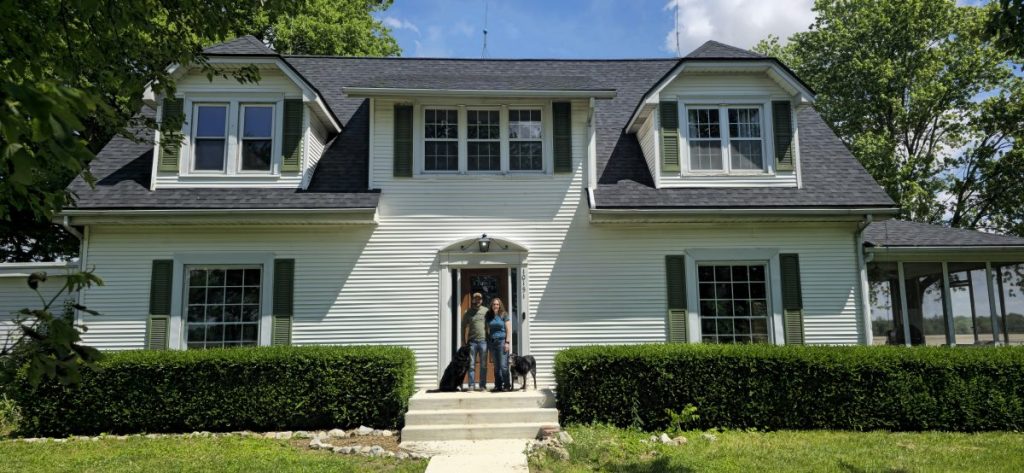
The Tarsha Homestead has had many names in the past, but was originally known as the “Lou-Dix Farm” after Louis “Huck” and Dixie Pfeffer, who built the farm house in 1920. Since being built it has changed hands a number of times. Pictured from left to right are Alex and Emily Tarsha, dogs from left to right are Nick and Josie.
By Zachary Daum
When Emily and Alex Tarsha bought their Lebanon farmhouse three years ago, they were simply looking for space — a few acres, an old home and the chance to live a more self-sufficient life. What they got was something more: a strong connection to one of the most important families in the town’s history.
“We didn’t know what we were getting into,” Emily said. “We just liked the look of it and it had what we were dreaming about — a farmhouse, some land, a pond, room for animals. We had no idea how much history came with it.”
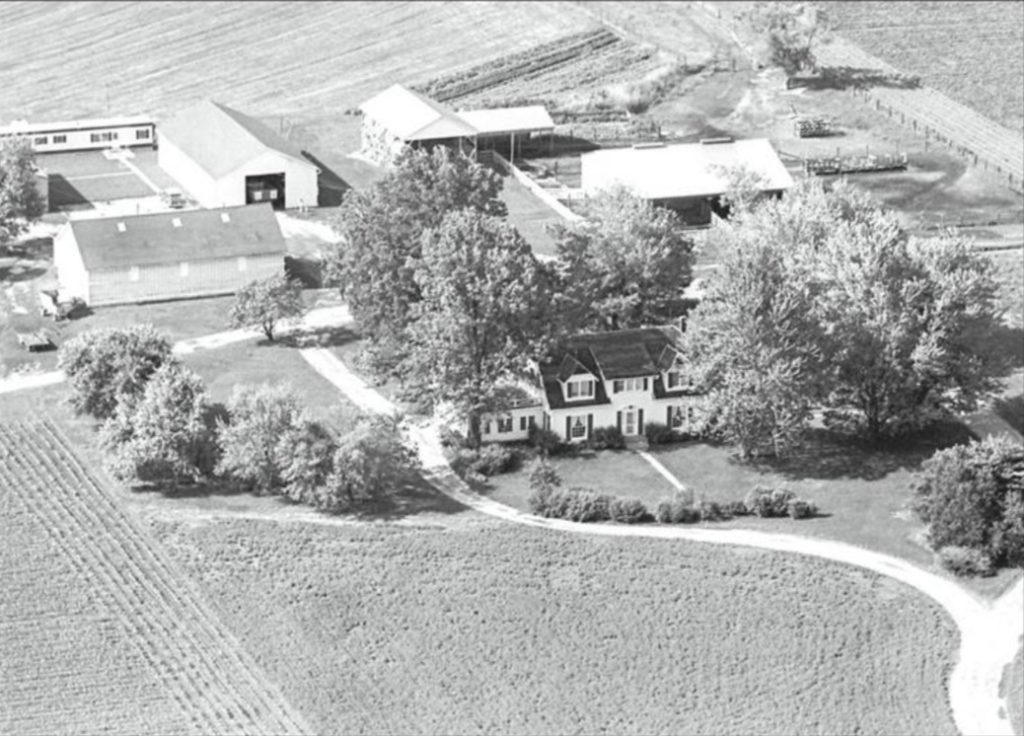
A photo was taken of the house from the sky in 1964 (Photo provided by Alex and Emily Tarsha)
That history belongs to the Pfeffer family, whose name was once synonymous with Lebanon’s growth. The Pfeffer Milling Company, founded by Christian Pfeffer and later run by his sons, employed hundreds in the 19th and early 20th centuries and helped build the local economy. Their influence was so significant that a trolley once ran from St. Louis to Lebanon to bring in workers.
In 1917, Louis Lorenz Pfeffer — Christian’s son and then-president of the mill — purchased 388 acres of farmland just outside of town. In 1920, his son, Louis Herman “Huck” Pfeffer, and his wife Dixie built the farmhouse that now belongs to the Tarshas. They called it the “Lou-Dix Farm,” a blend of their names.
The home stayed in the family for generations. After “Huck” Pfeffer had passed, his son, James Bradford “Brad” Pfeffer moved into the house with his three daughters, Mary, Jane and Nancy. The house exchanged hands several times as the years went on.
“There have been a lot of names for this place over the years,” Alex said. “The Lou-Dix Farm, the Dietz Farm and Dr. Needles’ Farm. But it was Huck and Dixie Pfeffer who really built this house and started its story.”
What started as casual curiosity quickly turned into a passion project. As the Tarshas began renovating the house — fixing the barn, updating the kitchen, repairing storm damage — they found signs of its past everywhere. One discovery in particular stood out.
“There’s a barn out back, and carved into one of the beams is ‘LLP, 13 years,’” Alex said. “We thought it might be Louis Lorenz Pfeffer at first. But when we looked at the dates, we realized it was his grandson — Louis Lawrence Pfeffer. He was 13 in 1933. That carving tied it all together.”
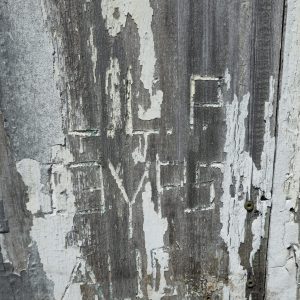
A carving by LLP 13 Years, carved into the still standing barn by Louis Lawrence Pfeffer in 1933
The Tarshas tracked down surviving members of the Pfeffer family, including granddaughters of Brad and Louis Lawrence. What followed was a remarkable reconnection between past and present.
Just a few weeks ago, three of Huck’s granddaughters — Jane and Nancy, daughters of Brad Pfeffer; and Kim, daughter of Louis — visited the farm to attend a small, private ceremony. Jane and Nancy’s sister, Mary, had recently passed away. The family chose to have her ashes spread on the grounds.
“It was really emotional,” Alex said. “They were standing in this house, sharing stories about growing up here, pointing out places in old photos that matched what we were seeing. Kim saw her father’s initials in the barn. That moment hit us hard — it felt like we were part of something bigger.”
“They told us about things we never would’ve known,” he also added. “Like how the porch used to be where the farmhands ate. And the room addition was built for Dixie when she had back surgery — just so she could have flowers and light while she was recovering. It’s those little things that make this feel real.”
The house has needed a lot of work. Tornado damage led to a full roof replacement. They had to redo the septic system, dig out and replace drainage around the basement, reinforce the barn, and update decades-old electrical wiring. There was once also a near fire disaster that left some scorching inside a wall. The kitchen is currently still a work in progress — Alex is building the cabinets himself.
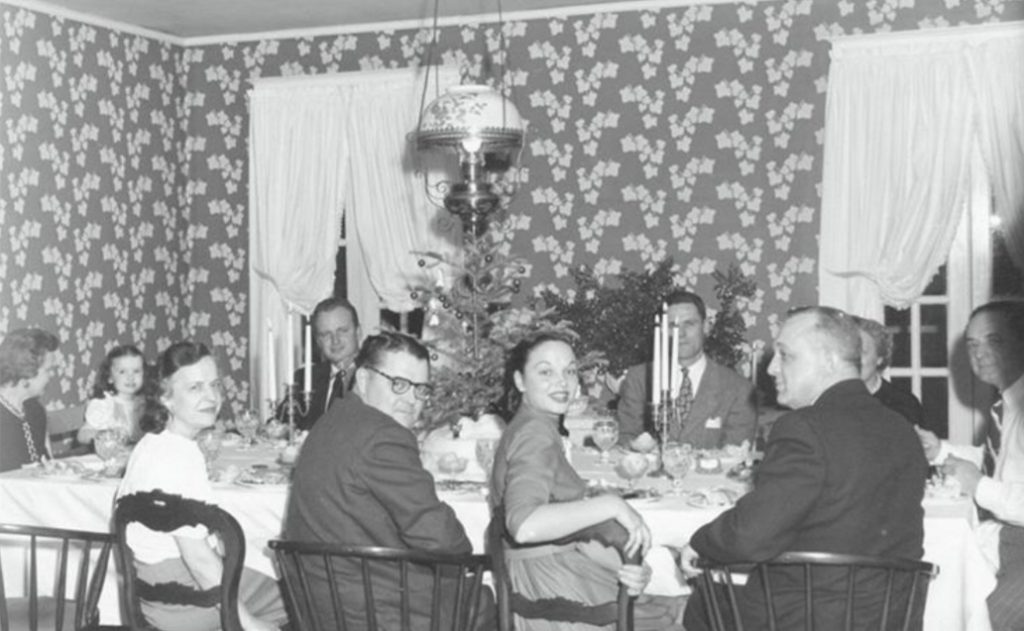
Above is a photo of the Pfeffer family holding a family dinner at the farmhouse sometime in the early 20th century. (Photo provided by Kim Pfeffer Carrol)
“We want this to be our forever home,” Emily said, making it clear that they are planning to spend a long time there. “That’s why we’re putting so much into it. It’s not about flipping a house. It’s about honoring it.”
Outside, the property has been transformed. The Tarshas now raise goats, chickens, pigs, and bees. They sell homemade goods through their farm store and host RV travelers through the Harvest Hosts program. It’s a far cry from their previous lives working government and tech jobs, but one they’ve fully embraced.
“This place is a lot of work,” Alex said, “but it’s also our therapy. Alex works in software and spends long hours at a desk on a computer. “I take work calls walking around the pasture. After sitting behind a computer all day, it’s a relief to do something with your hands.”
“We want our kids to grow up knowing where they come from, and for this to be a place that people remember,” Emily said. “The Pfeffers were a big part of this town’s story. Now it’s our job to take care of their legacy — and make our own along the way.”